
Few appliances are as easy to ignore as a water heater — right up until the morning it fails and you are standing in a cold shower. When that day comes, or when you are planning ahead, you will face a choice that has gotten more interesting over the last decade: stick with a traditional tank, or switch to a tankless unit. Both heat water well. They just do it in fundamentally different ways, and the right answer depends on your home, your habits, and your budget. Here is an honest breakdown to help you decide.
How Each One Works
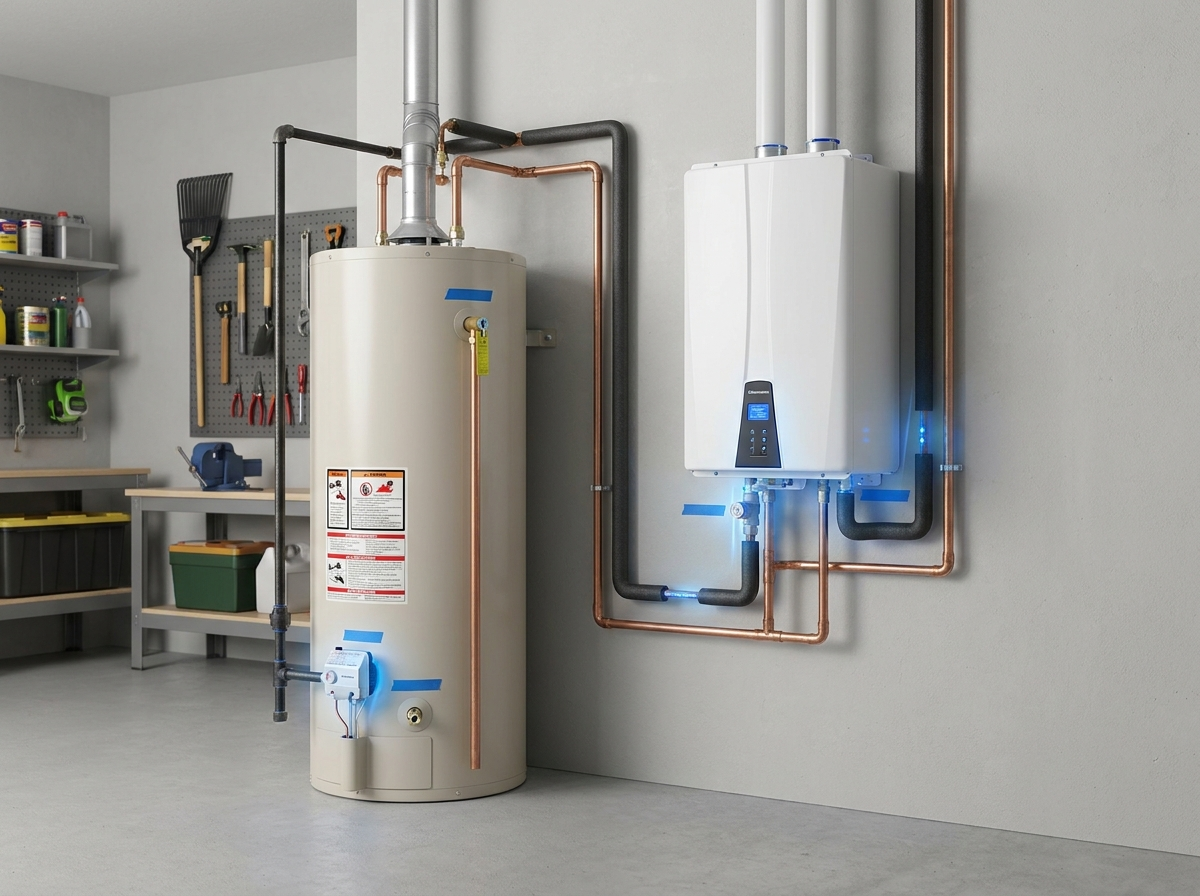
A traditional storage water heater does exactly what the name suggests. It keeps a tank of water — commonly forty to fifty gallons — heated and ready around the clock. When you open a hot tap, heated water flows out and cold water flows in to be warmed for next time. It is simple, proven technology that has been in homes for generations. A tankless, or on-demand, water heater holds no reservoir. When you open a hot tap, the unit senses the flow and fires a powerful gas burner or electric element that heats the water as it passes through, in real time. Turn the tap off and it stops. Because it only heats water when you need it, there is no tank of water sitting hot all day waiting to be used. That single design difference drives nearly every pro and con that follows.
The Case for Tankless
The headline advantage is efficiency. Because a tankless unit does not reheat a stored tank around the clock, it avoids what engineers call standby heat loss — the energy spent keeping water hot while you are at work or asleep. The U.S. Department of Energy notes that for homes using a moderate amount of hot water, tankless units can be meaningfully more energy efficient than storage models, with the edge narrowing in very high-use households. Over the long life of the unit, that can add up on energy bills. The second draw is endless hot water: a tankless unit can supply a continuous flow as long as the tap is open, so you will not run out partway through the third shower of the morning. Third is longevity and footprint. Tankless units often last longer than storage tanks — frequently twenty years or more with maintenance, compared to roughly ten to fifteen for a tank — and they are wall-mounted and compact, freeing up floor space. There is also no large tank of water to leak and flood a room if the unit fails.
The Case for a Traditional Tank
Tankless is not automatically the winner, and a good plumber will tell you so. The most immediate factor is upfront cost. A tankless unit itself costs more, and installation is often more involved — upgrading gas lines, adding venting, or increasing electrical capacity can all come into play, especially when converting a home built for a tank. A traditional tank is cheaper to buy and usually simpler and less expensive to install as a like-for-like replacement. Tanks also handle big simultaneous demands gracefully. If your household routinely runs the shower, the dishwasher, and the washing machine at once, a single tankless unit can struggle to keep up with the combined flow, sometimes requiring a larger unit or even two. A well-sized tank simply delivers what is already heated. Then there is the local wrinkle that matters a lot in our area: hard water. Sacramento’s mineral-rich water leaves scale behind, and tankless units are more sensitive to scale buildup on their heat exchangers than tanks are. A tankless unit in a hard-water home should be flushed regularly, and many installers recommend pairing it with a water softener or a scale-prevention system to protect it. Skip that maintenance and you can shorten the lifespan of an otherwise long-lasting unit. This is not a reason to avoid tankless — it is a reason to plan for the maintenance honestly.
How to Choose
Start with your household’s hot-water pattern. A large family with several bathrooms and lots of overlapping use may be well served by either a high-capacity tank or a properly sized tankless system — but that sizing conversation is essential. A smaller household, or anyone who hates running out of hot water, often loves tankless. If you are staying in the home for many years, the longer lifespan and energy savings of tankless have time to pay back the higher upfront cost. If you are on a tighter budget or replacing a failed unit on short notice, a quality tank may be the practical choice. Factor in your home’s existing setup, since converting from tank to tankless can require gas, venting, or electrical work that adds to the project. And in our hard-water region, budget for the maintenance — or the water treatment — that keeps a tankless unit healthy.
The Bottom Line
There is no universally correct answer, only the right answer for your home. Tankless rewards efficiency-minded homeowners who plan to stay put, want endless hot water, and will keep up with maintenance. A traditional tank rewards those who want lower upfront cost, simple installation, and strong simultaneous output. The best move is a conversation with a plumber who will look at your actual usage, your gas and electrical setup, and your water quality before recommending anything.
Not sure whether tankless or tank is right for your home? Plumbing Care Inc sizes, installs, and maintains both — and we will give you a straight recommendation based on your usage and Sacramento’s hard water. Call (916) 510-8804 (Sacramento and Placer County) or (925) 255-6352 (Bay Area).
Sources consulted (paraphrased, not quoted): U.S. Department of Energy consumer guidance on storage and demand (tankless) water heaters and energy efficiency; U.S. Geological Survey information on hard water and scale; general plumbing-industry guidance on water heater sizing, venting, and tankless maintenance in hard-water areas.
Related Reading
- Heat-Pump Water Heaters: Savings and Rebates
- Why High Water Pressure Is Costing You Money
- Drought-Smart Plumbing: Cut Water Use at Home
Comparing tank and tankless water heaters? Contact Plumbing Care Inc. to discuss your household’s hot-water needs and request a qualified evaluation. Mention PCI-BLOG-13006 when you call so our team can identify the post that brought you here.