
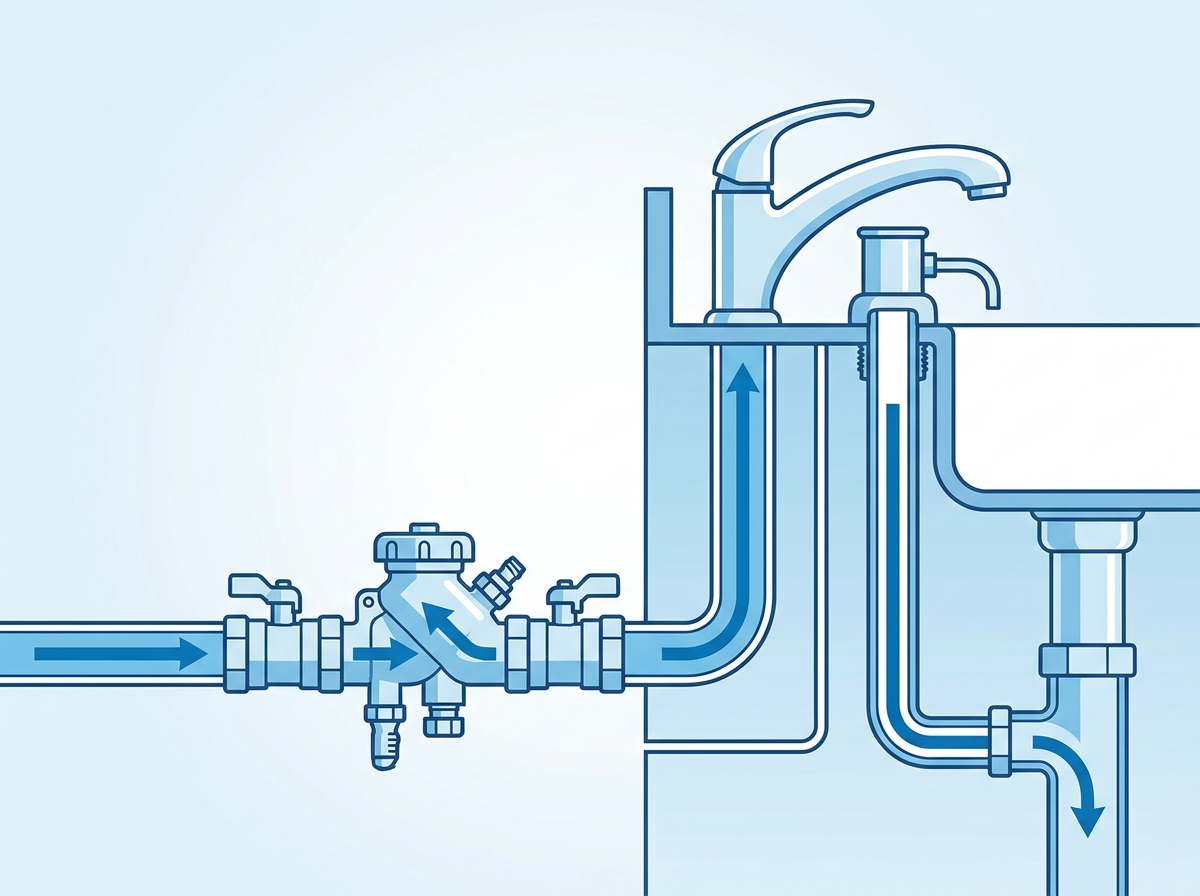
Turn on your kitchen tap and you expect clean, safe drinking water, every time, without a second thought. That reliability is not an accident. It rests on a quiet piece of plumbing science called backflow prevention, and on the plumbers, codes, and devices that keep the water flowing in only one direction. Most people have never heard the terms backflow and cross-connection, yet they are central to public health. Here is what they mean and why they matter in your home and business.
The One Rule of a Water System: One Direction Only
A building’s plumbing is designed as a one-way street. Clean, pressurized water enters from the public supply and travels to your fixtures and appliances. Wastewater and used water leave through a completely separate drainage system. The entire arrangement depends on those two systems never mixing. Backflow is what happens when that one-way flow reverses and used or contaminated water gets pulled or pushed backward into the clean supply. When that reversal happens at a point where the clean water and a potential contaminant can meet, called a cross-connection, the drinking water can become polluted.
What Is a Cross-Connection?
A cross-connection is any point where the potable water supply could come into contact with a non-potable source. They are more common than you would guess, and many are completely ordinary. A garden hose lying in a bucket of soapy water, sitting in a swimming pool, or attached to a chemical sprayer is a classic cross-connection. So is an irrigation system connected to the house supply, a boiler with chemical additives, a commercial dishwasher, or a fire-suppression system. In each case, the clean water and a potential contaminant are only separated by the reliable one-way flow of the system. Remove that reliability and the contaminant has a path back into the pipes.
How Backflow Actually Happens: Two Mechanisms
Backflow occurs through one of two physical mechanisms, and understanding them makes the risk concrete. The first is back-siphonage, which is caused by a drop in supply pressure. If pressure in the main falls suddenly, because of a water main break, heavy demand from firefighting, or a nearby hydrant being opened, the resulting suction can act like a straw, pulling water backward through any open cross-connection. A garden hose submerged in a contaminated liquid during such a pressure drop can siphon that liquid straight into the house plumbing. The second mechanism is back-pressure, which happens when a downstream source produces pressure higher than the supply. A boiler, a pressurized commercial system, or a booster pump can push its water, along with whatever it contains, back against the incoming supply and into the clean lines.
The Devices That Stop It
The engineering solution is a family of backflow prevention devices, each suited to a different level of risk. The simplest and most familiar is the humble air gap, a physical vertical space between a faucet outlet and the flood rim of a sink or fixture, which makes back-siphonage physically impossible because there is no connected path. You can see this designed into the gap between your faucet and the top of the sink. For hose connections, an inexpensive hose bibb vacuum breaker screws onto the spigot and prevents siphoning. More demanding applications use mechanical assemblies: pressure vacuum breakers for irrigation systems, double-check valve assemblies for moderate-risk connections, and the reduced pressure zone assembly, the most robust device, for high-hazard situations where a serious contaminant could be involved. Each device is engineered to close automatically if flow tries to reverse.
Why Testing and Compliance Matter
A backflow preventer is a mechanical device with springs, seals, and moving parts, and like any such device it can wear out or fail. That is why water authorities and plumbing codes typically require that backflow assemblies on higher-risk connections, common in commercial buildings, irrigation systems, and multi-unit properties, be tested regularly by a certified tester, often annually. The test confirms the device still closes properly and holds. Skipping it is not just a code violation; it leaves a real gap in the barrier protecting the community’s water. For business owners in particular, staying current on backflow testing is both a legal obligation and a genuine public-health responsibility.
What Homeowners and Businesses Should Do
For most homeowners, the practical steps are simple: never leave a hose submerged in anything you would not want to drink, use inexpensive hose bibb vacuum breakers on outdoor spigots, and make sure any irrigation system has a proper backflow device installed and functioning. If you have a pool, a boiler, or added a sprinkler system, it is worth confirming the right protection is in place. For commercial and multi-unit properties, the key is knowing where your backflow assemblies are, keeping them tested on schedule, and repairing or replacing any that fail. A licensed plumber can survey a property for cross-connections and recommend the correct devices.
An Invisible System Worth Understanding
Backflow prevention is one of those systems that works so well it becomes invisible. But the safety of the water at your tap depends on a chain of physical barriers doing their job silently, every day. Understanding cross-connections and keeping the right devices installed and tested is how that chain stays unbroken.
A Quiet System That Protects a Whole Community
It is worth appreciating just how much collective safety rides on these unglamorous devices. Your home’s backflow protection guards not only your own family’s water but, through the shared municipal supply, your neighbors’ as well. A single unprotected high-hazard cross-connection during a pressure event can, in principle, draw a contaminant into the local distribution system that many households share. That is why water authorities take backflow so seriously and why the testing requirements exist. When you keep a backflow assembly tested and functioning, you are participating in a public-health system that works precisely because thousands of individual barriers all hold at once. It is one of the clearest examples in plumbing of a small private responsibility adding up to a large public good.
Need a backflow device installed, tested, or a property surveyed for cross-connections? Plumbing Care Inc handles residential and commercial backflow protection across the Sacramento region and the Bay Area. Call (916) 510-8804 (Sacramento and Placer County) or (925) 255-6352 (Bay Area).
Sources consulted (paraphrased, not quoted): U.S. Environmental Protection Agency materials on cross-connection control and drinking-water protection; general plumbing-code and water-authority guidance on backflow prevention devices (air gaps, vacuum breakers, double-check and reduced pressure zone assemblies) and required testing.
Related Reading
- The Hidden Life of Your Water Main
- Galvanized, Copper, or PEX: Identify Your Pipes
- Why High Water Pressure Is Costing You Money
Need help evaluating a backflow or cross-connection concern? Contact Plumbing Care Inc. to request professional guidance. Mention PCI-BLOG-13013 when you call so our team can identify the post that brought you here.

1 comment on “Backflow and Cross-Connection: The Science of Keeping Drinking Water Safe”